The Pioneers: Andrew O’Brien & The de Wittes
The European history of the O’Brien family on Waiheke Island began in 1843 with a convergence of ambitious land speculators, diplomatic grand plans, and the harsh realities of the New Zealand frontier. Long before it became a farming region, the island’s early real estate was a battleground of overlapping land deeds, financial ruin, and cross-cultural negotiations.
The 1843 Arrivals: A Shared Horizon
In the winter and spring of 1843, the foundational figures of this story arrived in the infant capital of Auckland just months apart:
- The O’Briens: In July 1843, patriarch Andrew O’Brien and his 21-year-old son Laughlin stepped ashore from the brig Thomas Lord after a stormy trans-Tasman voyage from Sydney.
- Andrew quickly established himself as a merchant with a shop on Queen Street and then High Street. Along the way Andrew was asked to stand for Auckland Provincial Council which he did and was duly elected. Results are here and in Wikipedia here. Check out the map on that page. Six provinces for the whole of New Zealand. As well as being a merchant Andrew was involved in property deals and bought his property Eden’s Landing which was on the northern side of Khyber Pass near the intersection with Symonds Street.
- The de Wittes: On 14 November 1843, the barque Mandarin dropped anchor in Auckland. It carried Charles de Witte (who was appointed the New Zealand Belgian Consul 13 days after arriving), his wife Adele, their 12-year-old daughter Hélène, and their manservant Pierre de Norre.
- A Grim Cargo: In a stark reminder of early colonial realities, the Mandarin also carried 31 juvenile convicts from Parkhurst Prison, sent to labour in the new colony.
De Witte took advantage of Governor Robert FitzRoy’s controversial 1844 Pre-emption Waivers, which allowed private settlers to buy land directly from Māori chiefs.
- The Direct Deal (1844): De Witte struck a direct deal with the prominent Ngāti Pāoa chief, Wiremu Hoete (Jowett).
- The Price of an Island Base: He secured roughly 500 acres encompassing the Te Whau Peninsula and Pūtiki Bay with an initial down payment of £4, a promised follow-up of £40, and an additional £6 to construct a house.
- The First Footprint: The de Witte family established their first island homestead on the flat land near the sandy beach in Wharetana Bay. The construction date of the current house at Wharetana is not known but it is after February 1858.
Warts and All: The Frontier Friction
The hasty waiver system quickly plunged the de Witte holdings into decades of intense legal chaos. The boundaries were poorly surveyed, and the transactions ignored the deeply complex nature of customary Māori land rights.
- Overlapping Iwi Claims: De Witte purchased solely from Ngāti Pāoa, completely bypassing the overlapping customary and historical rights of the Ngāi Tai, Ngāti Tamaterā, and Patukirikiri (Ngāti Te Ata) iwi.
- Rival Speculators: Concurrently, an aggressive early trader named Adam Chisholm bought land at Pūtiki Bay from the Patukirikiri people, completely ignoring de Witte’s boundary lines. This sparked bitter, long-running feuds over who truly owned the soil.
- The Government Audit: In 1848, the new Governor, George Grey, cancelled the pre-emption waivers and aggressively audited all private deals. De Witte’s massive original claim was officially disallowed. It took until the late 1850s for Land Claims Commissioner Francis Dillon Bell to untangle the mess, finally issuing a drastically reduced 280-acre Crown Grant to the de Witte family.
Scandal on the Ridge
Before permanently retreating to the isolation of Waiheke, the de Wittes lived within Auckland’s high society on the elite ridge of St George’s Bay Road in Parnell. It was here that a young Laughlin O’Brien first courted Hélène de Witte.
But behind the diplomatic titles, the de Witte family was facing total social catastrophe.
- The Stigma of Bankruptcy: The crushing financial strain of trying to fund the failed Belgian colonization project broke the family coffers. Charles de Witte was forced into a highly public, humiliating bankruptcy—a setback considered an absolute moral and social failure in Victorian society.
- Before his financial collapse, de Witte and his family maintained a prestigious urban residence on St George’s Bay Road in Parnell. It was on this very ridge that the paths of the de Witte and O’Brien families intertwined, leading to the February 1856 marriage of de Witte’s daughter, Hélène, to the rising legal star Laughlin O’Brien.
- The Lifeline: When Laughlin O’Brien married Hélène in February 1856, he didn’t just marry the Consul’s daughter; he inherited a family recovering from financial ruin. Laughlin’s rising legal status and subsequent purchase of the land and building of the grand 11-room mansion at 19 St George’s Bay Road provided the financial fortress that saved the de Witte name from public disgrace until he was adjudged bankrupt in 1867. However he wasn’t alone, 21 others were bankrupted at the same time in April 1867 and Auckland town had a population of 11,000. What was going on?
By the late 1850s, the dream of a Belgian empire had vanished but it had existed. What remained was a single, hard-fought 280-acre coastal block on Waiheke Island—the historic anchor that Laughlin O’Brien would spend the rest of his life expanding into a 2,500-acre pastoral empire.
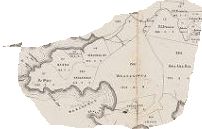
The Brother’s Correspondence: A Blueprint for Exile
While the idea of a Belgian metropolis in the Hauraki Gulf sounds like pure colonial fiction, Charles de Witte was deadly serious. In the mid-1840s, as the potato blight crippled Belgium, Charles wrote urgent, detailed letters to his brother back home, Jean-Joseph de Witte. He pitched Waiheke Island as the ultimate humanitarian life raft, arguing that 200,000 starving Belgian refugees could be systematically resettled across the island’s bays to build a new agricultural empire. Though Jean-Joseph tried to lobby for the scheme in Europe, the Belgian authorities ultimately rejected the plan as an expensive logistical impossibility, leaving Charles’s grand city to exist only on the pages of his private family letters.
Death Notices: Andrew, Pierre de Norre, Adele de Witte, Charles de Witte

March 22, 2023 at 11:06 am
Hi, this is a comment.
To get started with moderating, editing, and deleting comments, please visit the Comments screen in the dashboard.
Commenter avatars come from Gravatar.